Does Claude Watermark Its Output? What Anthropic's Text Watermark Actually Means for Your Business
Anthropic announced that Claude is putting an invisible watermark into the text it generates, and the reaction I saw was almost entirely panic.
People assumed it meant they were being tracked. That their clients would find out they use AI. That anything they wrote with help was now flagged somewhere.
None of that is what it does.
I read both of Anthropic's write-ups properly, and the reality is narrower and more interesting than the reaction. Here is what is actually true:
- It carries no identifying information and cannot be traced to a person, an organization, or a chat
- Nothing is added to the text, there are no hidden characters, and it costs nothing extra
- It exists to comply with the EU AI Act, applied globally only because there is no durable way yet to scope it by region
- Every major AI provider signed the same code of practice, so this is not a Claude thing
The watermark cannot prove a human didn't write something. It can only suggest Claude touched it.
Why the Claude watermark matters for your business
Because the limitation is the whole story, and almost nobody covering this got to it.
A detected mark tells you the content may have been processed by Claude. It does not tell you Claude wrote it. Anthropic says this plainly: people use Claude to proofread, translate, and summarize, so a mark can sit on text whose ideas came entirely from a person.
And it fails in the other direction too. Text with no mark is not proof a human wrote it. A short passage, a heavy edit, an older model, a file re-saved through a converter, and there is nothing left to detect.
It cannot prove the thing people fear, and it cannot prove the thing people want.
So if you were worried a client could run your proposal through a checker and catch you, that is not what this is. And if you were hoping to run a contractor's work through one and prove they used AI, that is not what this is either.
What it actually does is give the internet a weak, honest signal about where content came from. I think that is reasonable. I also think it changes far less about how you work than the headlines suggested.
What the watermark actually is, versus what people think it is
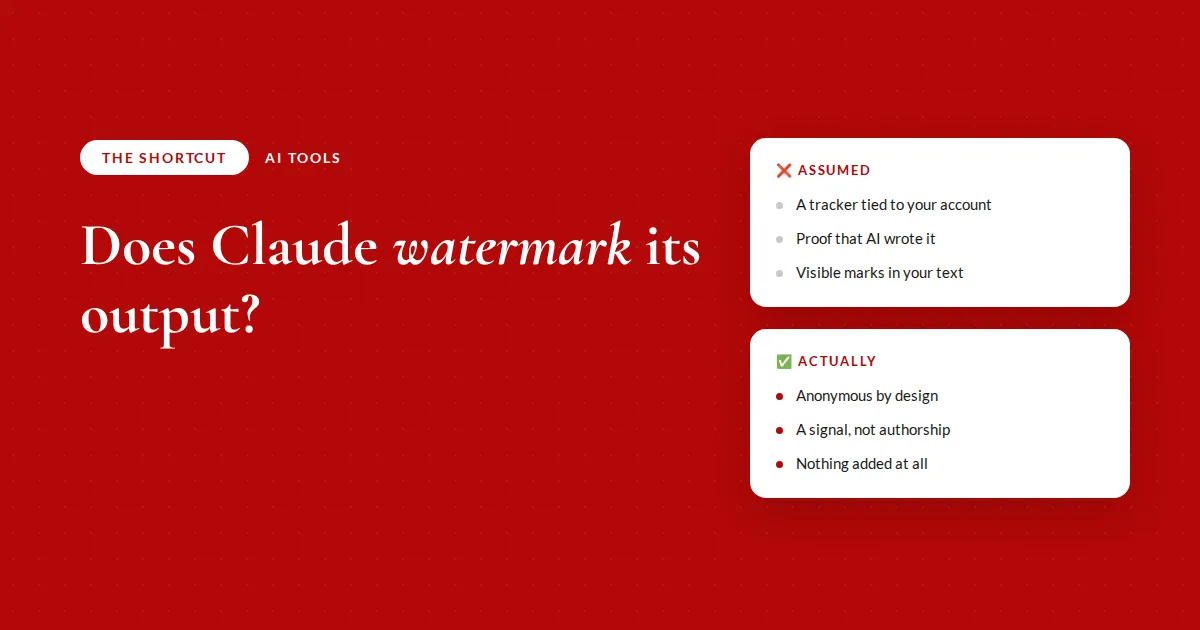
❌ What people assumed
- A tracker tied to your accountyour name attached to your output
- Proof that AI wrote somethinga pass or fail test
- Visible marks in your textcharacters to find and strip out
✅ What it actually is
- Anonymous by designno user, org, or chat information in it
- A signal that Claude may have touched itnot that Claude authored it
- Nothing added at alla pattern in word choice you cannot see
Where to start if you use AI in client work
- The work you hand to clientsProposals, reports, decks, anything with your name on it. This is where a disclosure question could realistically come up.
- The files you generate, not just the textClaude attaches signed provenance metadata to supported files like .png, .jpg, and .svg. That is a separate mechanism from the text watermark and it behaves differently.
- Whatever you already tell people about how you workIf you have a line about AI in your process, this is a good moment to check it still says what you mean.
- Your contracts, if you subcontractNot because of detection, but because "we use AI tools" is worth being explicit about either way.
Where to get AI disclosure language
I want to be clear about something here. I am not an attorney, and a disclosure line that goes in a contract or your terms is legal language, not copy.
So I am not going to hand you a template for it. What I would do instead is get it from someone qualified.
A better source than me
My friend Amira is an actual attorney, and she sells a done-for-you AI disclaimer template built for exactly this. If you want the AI language in your paperwork handled properly, start there rather than with a prompt.
That's an affiliate link. If you buy through it I may earn a commission, at no extra cost to you.
The takeaway
The watermark is not a detector and it is not a tracker. The thing worth doing in response is not hiding your AI use better. It is being clear about it in the first place.
Want to see how I actually use Claude?
Every week inside The Shortcut I document one thing I built, automated, or simplified in my own business, with the prompts and the reasoning behind it.
- The real builds, start to finish, not demos
- The prompts I actually ran, ready to adapt to your business
- The parts that broke, and what I changed
- Twice-monthly async coaching, plus a monthly live hot seat
Let's be real about what a watermark can and cannot settle
This will get used badly. Someone is going to run a piece of writing through a checker, get a result, and treat it as a verdict.
It is not a verdict. Anthropic is unusually direct about this: a detected mark is a signal, not a confirmation, and a missing mark proves nothing at all.
The other thing worth saying: detection is not fully available yet. Anthropic has said tooling is coming and that it will help third parties check for marks, but the detailed technical documentation has not landed. So anyone claiming today that they can definitively test your writing for a Claude watermark is ahead of the facts.
And again, none of this is legal advice. If AI use in your client work is something you need papered properly, that is a conversation for an attorney, not for me and not for a chatbot.
And if you are reading this hoping for a way around it, I would gently point at the actual problem. If you would be embarrassed for a client to learn AI was involved, the fix is a conversation about how you work, not a better way to hide it.
Common questions
Does Claude watermark its output?
Yes. Supported Claude models embed an invisible watermark into generated text by weaving a detectable pattern into word choices where several options would work equally well. Nothing is added to the text and there are no hidden characters. Claude also attaches signed provenance metadata to supported generated files such as .png, .jpg, and .svg, which is a separate mechanism from the text watermark.
Can a Claude watermark be traced back to me?
No. The watermark carries no identifying information. There is nothing in it, or in the key used to detect it, that reveals the user, their organization, or their conversation. It only indicates that content may have been processed by a Claude model, not who was using it or when.
Does watermarking change the quality of Claude's writing?
No. It changes only the source of randomness used when the model picks between words that are equally good in context, so a watermarked response reads the same as an unwatermarked one. It also adds no extra tokens, so it does not make responses slower or more expensive.
Does the watermark prove that AI wrote something?
No, and this is the most misunderstood part. A detected mark shows content may have been processed by Claude, which includes proofreading, translating, or summarizing text a person wrote. It cannot distinguish authoring from editing. The reverse is also true: content with no detectable mark may still be AI-generated, because short passages, heavy edits, and older models leave too little signal.
Why is Claude watermarking text at all?
To comply with the EU AI Act. Anthropic signed the EU Code of Practice on Transparency of AI-Generated Content along with around 190 other signatories, which requires providers to mark AI-generated text. It is applied worldwide rather than only in the EU because there is not yet a durable way to scope it by region, and other major AI providers are implementing their own marking under the same code.
Read the primary sources 🛠️
Everything above comes from these two, both worth reading in full:
- Anthropic · how Claude's text watermark works
- Anthropic Help Center · how Claude marks AI-generated content
- Claude · the tool this all applies to
I'm not affiliated with or endorsed by Anthropic. I'm a customer who read their documentation so you don't have to.