
How to Organize Your AI Skills (So You Stop Wasting Time Rebuilding)
This one started with a mildly embarrassing moment. I was halfway through building a skill when I realized I'd already built it a few weeks earlier. It was sitting there, finished, and I had completely forgotten.
And I don't think that's a me problem. I think it's what happens to anyone who builds a lot. You solve something, you move on, and you forget about it. It's not gone. It's just invisible:
- Skills and prompts scattered across files, notes, and old chats
- No single list of what you actually have
- So you rebuild things you already finished 😅
A skill isn't a file. It's your process written down. And it should belong to you, not to whatever AI tool you're using this year.
That's the bigger part for me. I've put a lot of time into turning how I work into skills: my voice, my processes, my decisions. I'm not planning to leave my AI tool. But all of that should be somewhere I own, no matter which tool I happen to be using.
Why I built this
The fix is a boring one, and that's why it works. Every skill I've built (or bought) lives as a row in one table I own in Airtable: the name, the trigger phrase that fires it, one plain line on what it does, and the full contents of the file.
And I store it twice, deliberately. The whole text goes in a long text field, and the actual .md file goes in an attachment field. That sounds redundant. It isn't, and this is the part I want you to hear.
The long text field is the one that changed how I work. Because my AI can read the table. So when I sit down to build something new, it already knows everything I've made and how I make it. It'll tell me I solved this back in April. Or it'll build the new thing to match the structure of the ones I already have, because it can see them.
The table stopped being a list I look at and became context my AI reads. Every new build starts with every old build behind it.
The attachment is the other half. That's the clean file, the thing I'd hand to a different tool if I ever wanted one. A copy I control.
Here's the opinion I'd push on. Most people think of "organizing" as tidying. Putting things where they go so you can find them later. That's the small win. The big win is that once your process lives somewhere readable, it compounds. Your AI stops starting from zero and starts from everything you've already taught it 🙌
And if you're thinking "I don't build skills, so this isn't for me," I'd push back. You should be. A skill is just a process you've explained once so you never have to explain it again. If you're re-typing the same instructions into AI every week, that's a skill waiting to be saved.
What actually changes
❌ Before
- Skills scattered across files or emailsno single list of what you have
- A list you'd have to update by handso it's out of date in days
- Everything living in one AI accountyour process sits somewhere you don't own
✅ After
- One table, every skillname, trigger, purpose, and the full file
- A weekly sync that runs itselfnew ones added, changed ones updated
- A copy you controlreusable now, portable to any AI tool later
Where to start
Build the table before you build the automation. Five columns is the whole design:
- Name and trigger phrase. Not just the name. "Flash sale skill" means nothing in six weeks. "Say 'run a flash sale', writes the sequence and the countdown" tells you at a glance whether to open it
- A one-line description. Written for someone who has completely forgotten this skill exists. No jargon, no shorthand
- The full contents, twice. The text in a long text field so your AI can read it, and the .md file as an attachment so you have the clean artifact
A database like Airtable does both. A spreadsheet can hold the text but not the file, which is a fine trade if you want the simplest version. Either way, it's easier to set up at five skills than at thirty, and you'll find ones you forgot you had.
Here's how to build the table
This is the prompt I'd start with. It sets up the structure and nothing else, so you confirm it's right before anything goes in. Drop it into whatever AI tool you use.
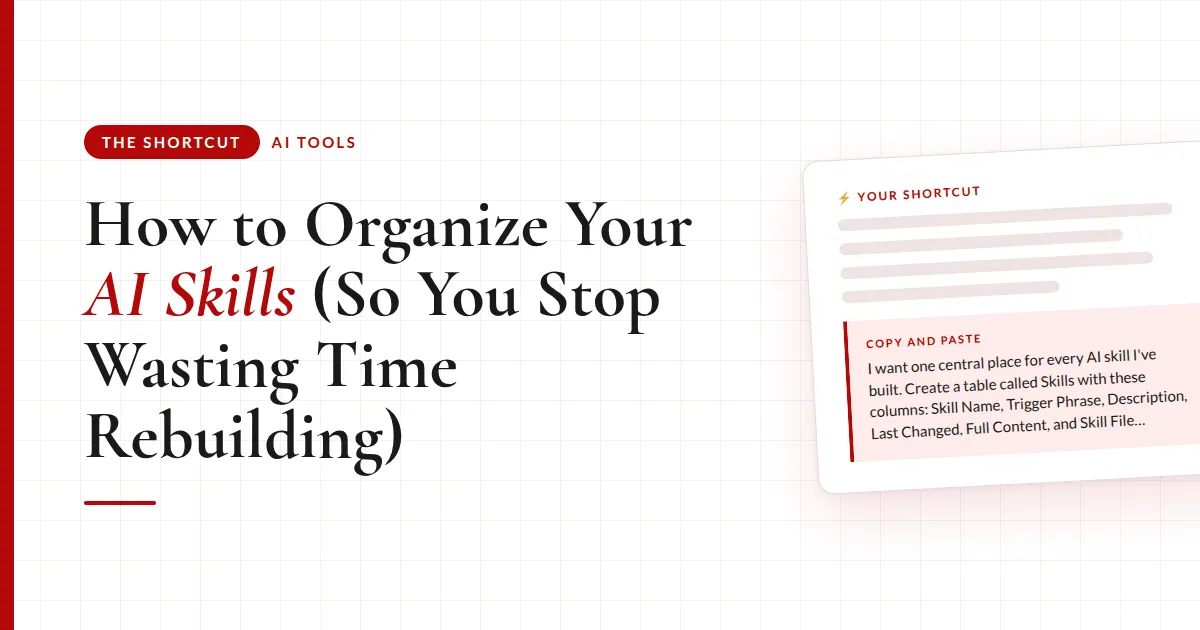
I want one central place for every AI skill I've built. Set this up in [Airtable or Google Sheets]. Create a table called Skills with these columns: Skill Name, Trigger Phrase, Description, Last Changed, Full Content, and Skill File.
Full Content needs to be a long text field that can hold the entire contents of a skill file, because I want my AI to be able to read it later for context. Skill File is an attachment field for the .md file itself.
Set it up empty for now and confirm the structure before adding anything.
If your AI tool is connected to your database, it can create the table for you. If it isn't, it'll give you the columns and you set them up by hand in two minutes.
The takeaway
Stop keeping your process inside one AI account. Put every skill in a table you own, store the full text so your AI can read it, and every new build starts with everything you've already built.
The full breakdown is inside The Shortcut
That prompt builds the table. Members get the part that fills it and keeps it honest:
- Prompt 2, which reads every skill you've already built and backfills the table, full file contents included, flagging anything missing a clear name or trigger
- Prompt 3, the scheduled sync that runs every Monday, touches only what's new or changed, and ends by creating a task listing exactly what moved
- Prompt 4, which makes your AI read the table before any new build so it reuses your patterns and tells you when the thing already exists
- Prompt 5, for moving a skill to a different AI tool without losing the trigger, the steps, or the voice
- The manual version if you have no connectors, and my audio walkthrough on why I store everything twice
A quick note about the syncs
Mine runs weekly because I build constantly. If you make a skill every few weeks, run it monthly. A sync that fires more often than you build is noise, and you'll start ignoring it.
And a backup you ignore isn't a backup.
There's also one piece I still do by hand: attaching the file. My AI can't drop the .md into the attachment field for me yet, so the sync ends by creating a task that tells me which skills changed. I go drop the files in. Twenty seconds. That's the honest version of "automated," and it's still a world away from keeping the list in my head.
Common questions
What is an AI skill?
A skill is a process you've written down once so your AI tool can run it again without you re-explaining it: the trigger phrase, the steps, the voice, and the decisions. If you find yourself typing the same instructions into AI every week, that's a skill waiting to be saved.
How should I organize my AI skills and prompts?
Keep them in one table you own, with a row per skill: name, trigger phrase, a plain-language description, the date it last changed, the full text of the file, and the file itself as an attachment. Airtable handles all of that; a Google Sheet works if you skip the attachment.
Why store the full text and the file separately?
The long text field is what your AI can read, so it has every existing skill as context when you build something new. The attached file is the clean, portable artifact you'd hand to a different tool. The text pays off day to day; the file saves you later.
Can AI keep my skills table up to date automatically?
Yes, if your AI tool can read your skill files and write to your database. A scheduled task can compare the files to the table, add new skills, update changed ones, and leave the rest alone. If there's no connector, paste each file into a chat once a month, ask for it back as clean markdown, and save it to a folder you own.
Can I move my skills to a different AI tool?
That's the point of owning the copy. Because the full content lives in your table, you can give any new tool the stored text and ask it to rebuild the skill in its own format, keeping the trigger, steps, and voice. Anything that doesn't translate cleanly gets flagged so you can decide what to do.
Recommended Resources 🛠️
- Airtable · where every skill lives
- AI Skill Shop · ready-made skills to add to your table
- Claude Simplified · how I set up Claude and skills
Some of these are affiliate links. If you buy through one I may earn a commission, at no extra cost to you. I only list tools I actually use.